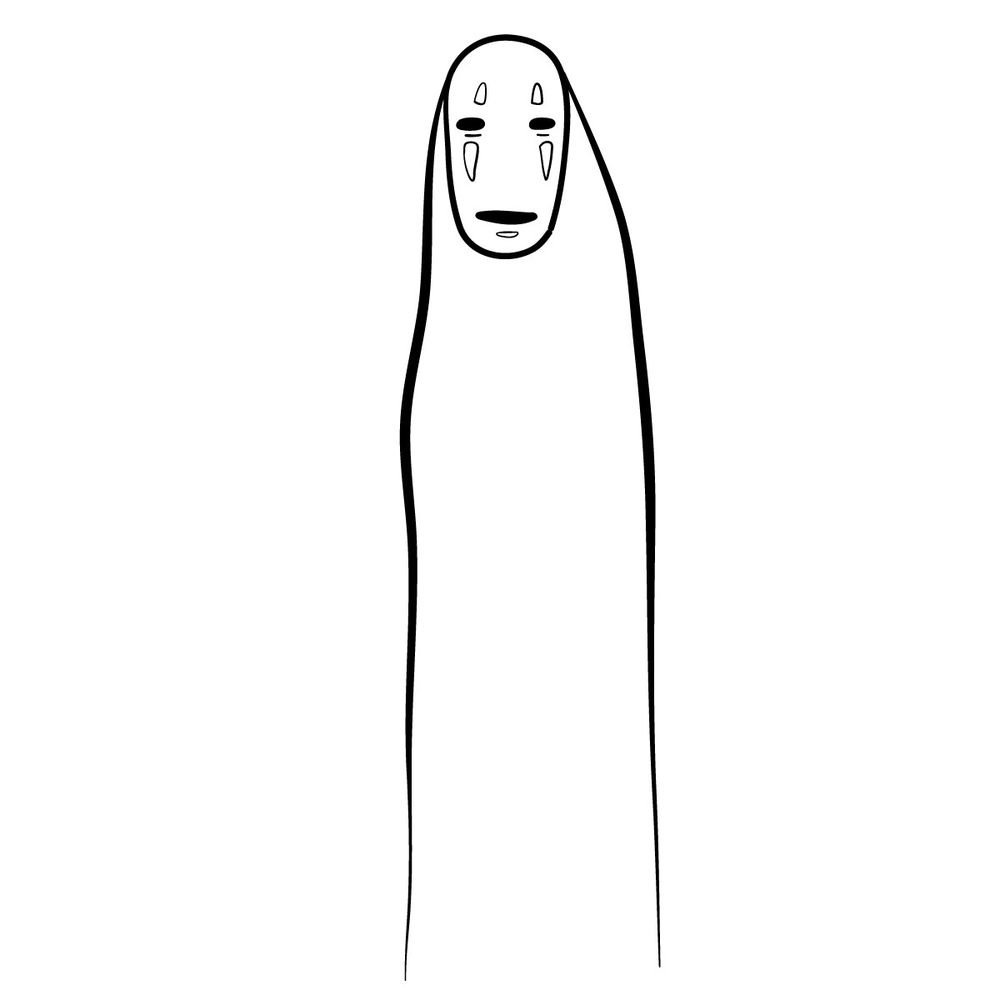
Capturing that narrow, flowing silhouette in just a few clean lines is the skill this guide focuses on, and No-Face from the Studio Ghibli collection is a solid subject for practicing exactly that kind of restrained, minimal linework. The how to draw No-Face tutorial keeps the shape count low, which puts all the pressure on getting the proportions right.
Six Steps, One of Ghibli’s Most Minimal Characters
The tutorial runs 6 steps from first sketch line to finished line art, with no color in the final result. All the focus stays on the silhouette itself: the elongated narrow body, the robe edges that taper toward the base, and the simple oval face that sits on a surprisingly thin neck. Proportions are the main thing to watch here. The body is much taller and narrower than it looks at first glance, and getting that tall-to-narrow ratio right is what most people need a couple of attempts to nail.
What No-Face Looks Like in This Drawing
- Tall elongated body in flowing robe
- Rounded oval head on narrow neck
- Two dark oval eyes, white highlights
- Small simple mouth near face base
- Body tapers to thin trailing edges
If you want more Ghibli characters to sketch after this one, the chibi and big Totoro guide covers two size variations in one walkthrough, the Kodama tutorial is another minimalist spirit with a similarly simple face, and Turnip Head from Howl’s Moving Castle adds a bit more structural complexity to work through. All three are worth trying once you’ve got No-Face’s proportions down.
Reading the Step Colors in the Guide
Each step image uses a three-color system to show what’s new and what’s already done:
- Red Color: lines added in the current step.
- Black Color: lines completed earlier.
- Gray Color: base sketch for structure.
How to Draw No-Face: Step-by-Step Tutorial


Finished Your No-Face? Share It
Drop your finished drawing in the comments below. Seeing how others handle that narrow silhouette is always useful, and it helps other people working through the same steps. All new tutorials go straight to Facebook and Telegram as soon as they’re published, a new YouTube video based on existing guides goes up every day, and Pinterest gets updated regularly too. If you enjoyed this one, the Sheeta and Pazu tutorial is a good next step up in complexity, and Princess Mononoke and Moro is there when you’re ready for something more detailed. Supporting the project on Patreon also unlocks hand-drawn coloring pages that aren’t available anywhere else.